
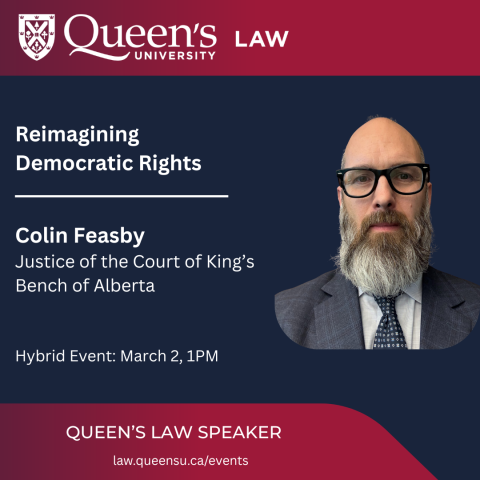
This is a hybrid event
Register to attend in-person or via zoom here
Reimagining Democratic Rights
Democratic rights are the most important rights in the Charter because they are what restrains authoritarianism; they are exempted from the Notwithstanding Clause so that democracy cannot be legislated out of existence. Justice Feasby will argue in this presentation that our democratic rights jurisprudence is based on historical fiction, lacks a coherent political theory, and uses a Charter interpretive methodology that is anomalous. The Supreme Court of Canada’s substitution of fuzzy derivative rights like “effective representation” and “meaningful participation” for the actual rights provided for in Charter s 3 insulates limits on democratic rights from genuine scrutiny and leaves democracy vulnerable to abuse. He will propose a new approach to the Charter s 3 rights to vote and to stand for election. Justice Feasby contends that democracy would be better protected by a modest approach to Charter s 3 that hews closer to the constitutional text and recognizes the purpose of democratic rights as only to be protection for the minimal conditions of democracy.
Justice Colin C.J. Feasby graduated from the University of Alberta Faculty of Law in 1998. He later attended Columbia University where he earned an LL.M and J.S.D. He practiced at Osler for over 20 years, serving the Managing Partner of the Calgary Office for four years. As a lawyer, Justice Feasby had an active trial and appellate practice acting for corporate clients as well as a significant pro bono public interest practice. He appeared before many courts across the country, including the Supreme Court of Canada several times. He has written extensively on constitutional law subjects, particularly concerning democracy issues. He was appointed Queen’s Counsel in 2020 and then to the Court of Queen’s Bench of Alberta in 2021. In his time as a justice, he has written many significant decisions including concerning the rights of family members to intervene in patient decisions about Medical Assistance in Dying, the constitutionality of changes to Alberta regulations governing opioid prescription, the constitutionality of the Alberta Personal Information Protection Act, and whether a referendum on the independence of Alberta from Canada contravenes Charter and Treaty rights.