

Message from the Dean
Dear readers,
The Queen’s Faculty of Law Strategic Framework 2021-2026, draws to a close this year. This moment provides us an opportunity to reflect on our significant achievements, learn from our experiences, and collectively envision the future we want to create at Queen’s Law.
 Over the coming months we will undertake a broad and inclusive consultation process—through surveys, town halls, group engagements, and working group sessions to gather ideas from across our Queen’s Law community to inform our priorities.
We will honour the trajectory set by our previous Framework—our dedication to excellent legal education, research that shapes public life, and a community committed to access to justice and reconciliation—while reaching further to meet new challenges and opportunities.
As we embark on this important strategic planning journey, I encourage each member of the Queen’s Law community to reflect on your vision for our future and what matters most to you. Your insights and aspirations will be invaluable as we shape a bold, inclusive, and forward-thinking plan together. Thank you for your thoughtful engagement and commitment to our shared mission.
Kind regards,
Dean Colleen M. Flood
Proposed Timeline
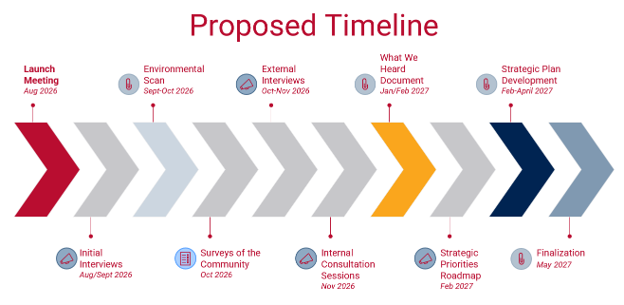
| Description | Date |
|---|---|
| Launch Meeting | Aug 2026 |
| Initial Interviews | Aug/Sept 2026 |
| Environmental Scan | Sept/Oct 2026 |
| Surveys of the Community | Oct 2026 |
| External Interviews | Oct/Nov 2026 |
| Internal Consultation Sessions | Nov 2026 |
| What did we hear document | Jan/Feb 2027 |
| Strategic Priorities Roadmap | Feb 2027 |
| Strategic Plan Development | Feb-April 2027 |
| Finalization | May 2027 |
2026-2027 Consultation Process
The Faculty’s strategic framework is a roadmap to help guide our decisions and actions, and inspire the very best in our students, faculty, staff, alumni and partners. We encourage all members of the Queen’s Law community to participate in the consultations to share your perspectives, insights, and help us arrive at a common vision for the future of our school.
Ways to participate:
- Community Survey – <Take the survey here>
- Town Halls – Open to all
| Session | Date | Time | Location |
| Town Hall 1 – In person | November 18, 2026 | TBC | TBD |
| Town Hall 2 – In person | November 19, 2026 | TBC | TBD |
Additional consultation sessions to be added.
In the event that the timing of sessions is not convenient, you can also address the Committee privately at law.strategic.planning@queensu.ca.
Strategic Planning Working Group Membership
Leadership and strategic direction throughout the process to create Law’s new strategic plan will be provided by a Working Group that represents stakeholders from across the Queen’s Law community. Working closely with Higher Education Strategy Associates, members will help shape consultation priorities, review and interpret findings, identify emerging themes and opportunities, contribute to the development of strategic recommendations, and refine the final plan. The Working Group will play a key role in ensuring that the consultation process is meaningful and that the resulting strategic plan reflects the aspirations, values, and priorities of the Queen’s Law community.
- Professor Cherie Metcalf – Associate Dean Research, Working Group Chair
- Professor Lindsay Borrows – Queen’s Law Professor, Indigenous Law & Governance
- Hugh Christie, Law’81 – Dean’s Advisory Council Chair
- Andrea Speltz - Education Development & Instructional Designer
- Margie Gordon – Director, Student and Academic Services, JD
- Professor Erik Knutsen – Faculty
- Roya Rouzbehani – Assistant Dean, Graduate Studies and Professional Programs
- Gabriella Zappulla – Law Student Society President
- Jacqueline Bell – Administrative support to the Working Group
You may contact them individually or at the Committee's dedicated email address at law.strategic.planning@queensu.ca
What We Heard
Following the collection of input and information through small group discussions, town halls, interviews with external interested parties, the environmental scan, and the community survey, HESA will summarize the takeaways into a What We Heard report, which will be available on this website. Accompanying this report will be a short questionnaire providing the community with another opportunity to voice their perspective—share what the What we Heard gets rights, and may what needs to be added or refined before drafting. After this detailed preparation work that ensures that the strategic planning process is truly aimed at our commonly-identified collective future, the work of drafting the actual plan begins.
Strategic Framework 2014-2019
Download a summary of the Strategic Framework (PDF, 650KB).
Building on the past, innovating for the future
The Faculty of Law’s Strategic Framework, a planning document for the next five years, was developed at the Faculty over the winter of 2013—2014 and ratified in the spring of 2014. It was created not only to encourage and ensure the continual evolution of the Queen’s Faculty of Law, but also to work within the context of a number of specific challenges.
The Strategic Planning Committee – a multifactorial group including representatives of the faculty, alumni, professional and student communities – have identified the following as our strategic goals for the Framework:
- Dynamic faculty
An intellectually vigorous, engaged and diverse faculty that enhances a vibrant research and teaching culture. - Innovative education
An innovative law student experience and curriculum that is responsive to a changing legal profession. - Student success
Quality education that positions students to attain their career objectives. - Engaging atmosphere
A distinctively collegial, diverse and inclusive environment for faculty, staff, and students.
Concrete goals to meet contemporary challenges
Meeting the above objectives will take distinct steps. The Framework outlines the five goals that must be met to ensure the Faculty is prepared for contemporary challenges in legal education.
- Expand enrollment
- Increase faculty and research footprint
- Deliver educational outcomes that ensure student success
- Enrich the Faculty community as a collegial, diverse and inclusive institution
- Create varied and innovative revenue streams