
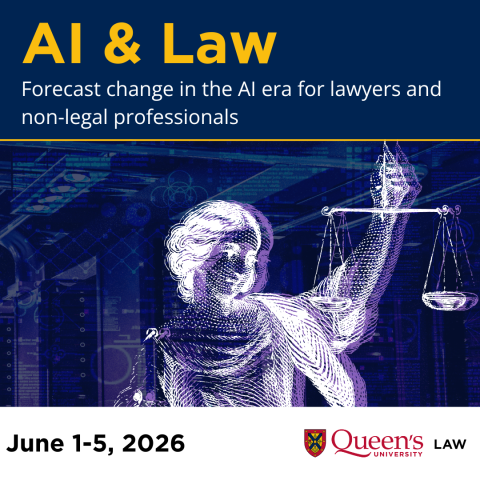
Queen’s Law will offer its popular AI and Law Professional Intensive from June 1 to 5, 2026, as artificial intelligence continues to transform the practice of law, the delivery of legal services, and access to justice in Canada.
Delivered fully online over five days, the program combines live, expert‑led lectures with interactive breakout sessions, bringing together participants from a wide range of professional backgrounds. Designed for lawyers and non‑lawyers alike, the intensive bridges theory and practice to provide a foundational understanding of AI in the context of Canadian law.
The intensive is designed for lawyers in private and public practice, in‑house counsel, government professionals, academics and researchers, as well as individuals working in startup and large‑scale business environments.
“I would highly recommend the Queen’s AI and Law Intensive to anyone seeking to stay at the forefront of technological and legal developments,” says past participant Clyphendie Pierre‑Louis, Director General, Services to Business Branch, at the Canadian Intellectual Property Office. “The course’s interdisciplinary approach equips you not only with a solid understanding of AI’s impact on legal practice but also with the tools to anticipate and address future challenges in the field of law. It’s an investment that will deepen your expertise and broaden your perspectives, making you a more effective and innovative leader.”
“Join us for a whirlwind tour of how AI is reshaping legal practice,” says Colleen M. Flood, Dean of Queen’s Law, who will teach a session on health AI. “The intensive invites participants to engage critically with evolving legal questions raised by AI across different areas of law.”
Flood is among the leading scholars and experts in legal AI who teach in the intensive, which draws on interdisciplinary research and research‑informed perspectives from across law, policy, and related fields. Sessions are led primarily by academic experts from Queen’s Law and other Canadian law schools, alongside a session on Canada’s evolving AI regulatory landscape, led by George Wray, a partner at Borden Ladner Gervais LLP with extensive experience in product law.
Across the five days, participants will explore topics including AI governance and regulation, the future of work, data governance and privacy, ethics and professional responsibility, administrative accountability, copyright and generative AI, algorithmic bias, criminal law, and health AI.
“AI technologies are both thirsty for data and capable of generating new data, raising important challenges for privacy,” says Professor Teresa Scassa (University of Ottawa), Canada Research Chair in Information Law and Policy. “Participants will learn of some of the ways in which privacy laws in Canada are already being interpreted and applied to AI technologies, and how the law will continue to evolve in this area.”
Accredited by the Law Society of Ontario, the intensive provides Continuing Professional Development hours for eligible lawyers, including four hours of Professionalism Content and 24 hours of Substantive Content. All participants who complete the program receive a digital certificate and digital badge from Queen’s Law.
The course fee is $2,300 (CAD) plus HST. Discounts are available for organizations, non‑profits, NGOs, and educational institutions.
Learn more and register on the AI and Law Professional Intensive webpage.