
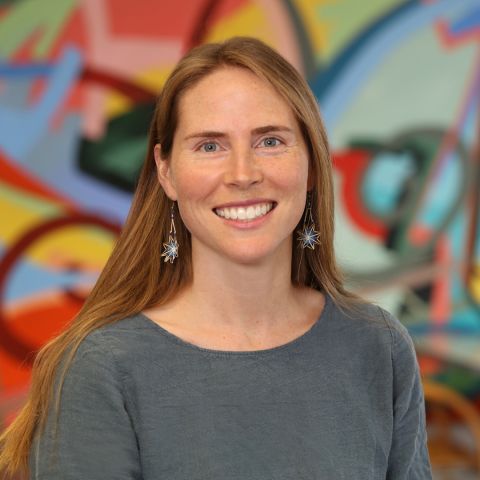
When Professor Lindsay Borrows first worked with a coastal First Nation responding to a devastating oil spill, she began thinking differently about law and governance.
She joined community members, scientists, artists, harvesters, Elders, and legal practitioners in discussions about how to heal damaged marine ecosystems that carried cultural, spiritual, and economic importance. The process drew on stories, ceremony, relationships, and collective responsibility to the land and water, reflecting forms of governance and decision-making not typically recognized within conventional legal frameworks.
That experience continues to shape Borrows’ work on Indigenous law and environmental governance and has led to her selection as one of the Canadian Institute for Advanced Research’s (CIFAR) 2026-2028 Global Scholars. She is among 15 early-career researchers from around the world selected for the program, which brings Canadian and international scholars together to pursue collaborative research on major scientific and social questions.
As part of the appointment, Borrows will join CIFAR’s Future Flourishing research network, one of several interdisciplinary programs that Global Scholars join based on their research areas. The network explores what it means for humans to live well alongside the natural world without placing humans above other forms of life.
Indigenous law in practice
Borrows studies how Indigenous legal traditions can help communities respond to challenges such as climate change and biodiversity loss. A member of the Chippewas of Nawash First Nation, she also examines Indigenous constitutions and the growing “Rights of Nature” movement, which explores how legal systems recognize responsibilities to land, water, and ecosystems.
“Indigenous legal traditions offer important ways of thinking about law, responsibility, and environmental change,” says Borrows. “The Global Scholars program creates opportunities to explore those questions alongside researchers approaching them from very different perspectives.”
Borrows’ work often takes place outside traditional academic settings. Since 2014, she has co-facilitated Anishinaabe Law Camps that bring together law students, lawyers, judges, and Indigenous community members for land-based learning experiences. Participants study Indigenous law through stories, ceremony, language, and direct engagement with the environment.
She is also collaborating with the Kingston Native Centre and Language Nest on research supporting the development of the Kingston Indigenous Legal Centre. The multi-year project examines wise practices for Indigenous legal services centres across Canada and aims to support community-led approaches to justice and healing.
Borrows has also focused on raising awareness about Indigenous legal traditions through public talks and presentations. In the first three years of her appointment at Queen’s, she delivered more than 50 presentations to audiences ranging from high school students and lawyers to engineers and scientists.
“This recognition reflects the strength of research at Queen’s that is deeply collaborative, community-engaged, and internationally relevant,” says Nancy Ross, Vice-Principal (Research). “Work that brings different areas of knowledge and experience into conversation is increasingly important in addressing complex social and environmental questions.”
A global cohort of emerging researchers
Now entering its eleventh year, the CIFAR Global Scholars program selected its 2026 cohort through a competitive international process that attracted more than 450 applications from 41 countries, the largest applicant pool in the program’s history. Scholars also receive $100,000 in research funding to support new and ongoing work.
“Early-career researchers are at the stage where community, mentorship and support can absolutely change the trajectory and impact of their research,” said Rachel Parker, Head of Next-Generation Initiatives at CIFAR. “Through CIFAR’s Next-Gen programming, such as CIFAR Global Scholars program, we are creating space for these exceptional researchers to conduct meaningful collaboration across disciplines and geographies, take bold steps in their research and grow as leaders within a global research community.”
Borrows is the third Queen’s University researcher to join the CIFAR Global Scholars program, following faculty members Élise Devoie (Civil Engineering) and Dalitso Ruwe (Political Studies), who were both named scholars in 2023.
Learn more about this year’s CIFAR Global Scholars.
(This story was originally published in the Queen’s Gazette.)