
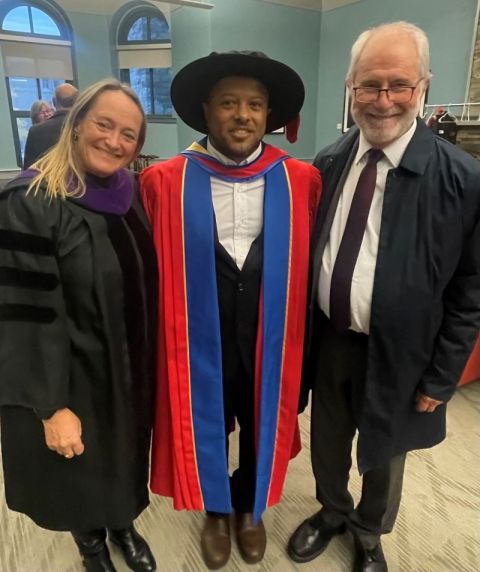
When Abebe Assefa Alemu, PhD’25, chose to write his thesis on deaf access to the criminal justice system in Ethiopia, he was inspired by a tragic childhood memory.
“There was a deaf girl, who was my neighbour; she was raped and became pregnant. The girl was blamed for that incident, and nothing happened to the perpetrator. She had been a strong student from a poor family, gave birth to a daughter, dropped out of school, and her future was ruined,” Alemu recalls.
“Since that time, particularly after I started law school, I have wondered, ‘Is this how the justice system works for deaf people?’”
Barriers to justice: learning from lived experience
In his doctoral thesis, “Navigating Systemic Barriers: Experiences of Deaf Persons in the Criminal Justice System in Ethiopia,” Alemu investigates the experiences of deaf people as victims, suspects, and accused in his home country’s criminal justice system.
Using a qualitative, socio-legal research design, he conducted 27 intensive interviews with deaf people, judges, police officers, prosecutors, policymakers and sign-language interpreters. “I used sign-language interpreters to communicate with and interview deaf participants,” he says.
His study was enriched by a critical analysis of Ethiopia’s legal framework, international normative frameworks, and comparative insights from Canadian jurisprudence.
“I wanted to address important questions, such as: What barriers do deaf people face? What legal mechanisms are available or needed? What can we learn from Canadian jurisprudence?”
Call for urgent and far-reaching reforms
Alemu’s findings call for urgent reforms. Latest reports estimate that about 3.6 million deaf and hearing-impaired people live in Ethiopia, yet major communication gaps persist in the provision of procedural accommodations within the criminal justice system.
“Deaf and hearing-impaired people rely on different means of communication, such as sign language, to understand the process and effectively exercise their fundamental rights,” says Alemu.
But the system relies on spoken language and is predominantly managed by hearing professionals, raising critical concerns about accessibility and participation. “In practice, many deaf people can’t afford or don’t have access to sign language interpreters,” he says.
Lifting legal barriers to justice
Legal barriers are significant. “Under the laws in Ethiopia, deaf people are considered mentally incapable. That law must be removed,” Alemu says.
Ethiopia is a signatory to the UN Convention on the Rights of Persons with Disabilities (CRPD), but Alemu found that this international human rights treaty is not enforced in practice.
“Ethiopia must take concrete steps to implement the CRPD, including ratifying its Optional Protocol and the Protocol to the African Charter on the Rights of Persons with Disabilities,” he writes. “Legal frameworks must be revised to ensure accessible and inclusive justice for all.”
He also calls for mandatory training for legal professionals to enhance awareness and promote equitable access.
Taken together, communication and legal barriers, limited awareness and deeply rooted biases amount to a denial of fundamental human rights, Alemu argues.
His PhD examination committee unanimously passed Alemu and commended him on an exceptional thesis.
Research to influence policy in Ethiopia and beyond
Alemu has presented his findings at several conferences and is preparing a monograph, with additional manuscripts are in the pipeline. “My hope is that these publications will influence policymakers in Ethiopia to implement reforms to protect the rights of deaf people. I believe my research is also relevant to many countries in the Global South where there is very little evidence and jurisprudence to accommodate the unique needs of deaf people,” he says.
Why Queen’s Law?
Alemu chose Queen’s Law because its philosophy aligned with his values. “Queen’s Law offers the ideal environment for the kind of legal scholar I want to be. It has a strong reputation for academic excellence and a commitment to public service and social justice,” he says. “Its programs are forward-looking and responsive to emerging social issues, and the faculty constantly adapt real-world challenges into the curriculum.
“The resources and faculty at Queen’s Law are exceptional”, he adds.
Support from mentors in overcoming obstacles
Near the end of his field research in Ethiopia, Alemu faced an unexpected incident, in addition to the devastating war in his country. It was a deeply shocking experience with lasting impacts, he recalls. Through the unwavering support he received at Queen’s and his own resilience, Alemu successfully completed his project. “I couldn’t have done it without the amazing support of my supervisor, Professor Cherie Metcalf.”
Being a Mastercard Scholar shaped his advocacy
The Mastercard Foundation Scholars program, a partnership between Queen’s and the University of Gondar (UoG) in Ethiopia, provides opportunities for UoG students and faculty to pursue graduate training related to disability in Africa.
“The fellowship I received as a Mastercard Foundation Scholar made it financially possible for me to pursue my PhD and undertake this groundbreaking project,” says Alemu, who holds an LLM from Bahir Dar University and an LLB from Hawassa University, and taught for a decade at UoG’s Faculty of Law, where he held academic leadership roles, including Legal Aid Director and Dean of the School of Law.
“This project has completely shaped my perspective. What I want to do next is teach future lawyers about disability law and people with disabilities,” he says. “I will never stop being an advocate for persons with disabilities, and my long-term goal is to be a dedicated advocate for people with disabilities in general.”
Interested in graduate studies at Queen’s Law? Learn more at the Graduate Program webpage.
By Mark Witten