
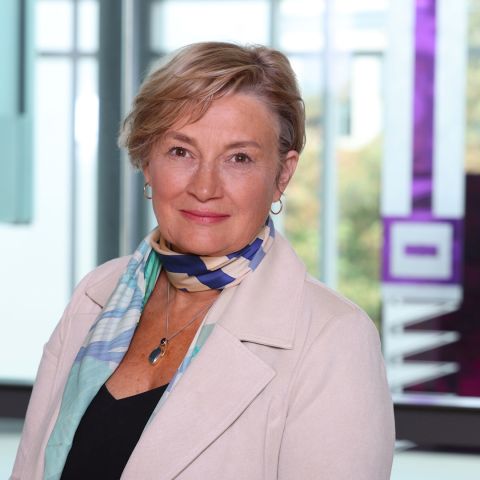
Dean Colleen M. Flood has received $355,724 from the Canadian Institutes of Health Research (CIHR) for a global project examining how medical device regulation can better support the safe and effective use of artificial intelligence (AI) in health care. The project is co-led with Professor Catherine Régis (Université de Montréal), Professor Anna Goldenberg (The Hospital for Sick Children/University of Toronto), Dr. Devin Singh (The Hospital for Sick Children), and Professor Teresa Scassa (University of Ottawa).
“Health-AI has the potential to radically improve access to care, enhance quality, and support more efficient and equitable health systems,” says Flood. “Realizing that promise, however, depends on addressing real and evolving risks so that Canadians receive the safe, high-quality care they deserve.”
Titled “Optimizing Medical Device Regulation of Artificial Intelligence,” the four-year study focuses on how Canada’s medical device framework can continue to evolve to respond to rapidly advancing technologies, particularly machine learning and generative AI. While Health Canada has already taken important steps to modernize oversight in this area, the pace and adaptability of regulation will be critical. The project emphasizes learning from other jurisdictions to identify agile regulatory approaches that can respond to AI systems that evolve over time, perform differently across clinical settings, and introduce new forms of risk.
Flood, a leading scholar in health law and policy and team lead of the CIHR-funded Machine M.D. research initiative, notes that AI challenges traditional regulatory assumptions about static technologies.
“Ensuring patient safety, public trust, and sustained innovation requires regulatory approaches that can adapt alongside technological change.”
The project will analyze and compare regulatory frameworks in Canada, the United States, the United Kingdom, the European Union, Australia, Brazil, and Nigeria. Working with a global network of researchers, regulators, patient groups, Indigenous communities, and health professional organizations, the team will develop model laws and regulatory tools that protect patients while supporting responsible innovation. A public, online evidence base will track safety issues and regulatory responses throughout and beyond the project.
“The goal is to position Canada not only as a global leader in health-AI innovation, but also in the regulatory approaches that make such innovation safe, trustworthy, and scalable,” Flood says. “Innovation and regulation are interdependent — and Canada’s success depends on advancing both together.”
Dean Flood will give a public talk titled “Machine M.D.: The Governance of Health-Related AI” on Feb. 12 from 12–2 pm in Robert Sutherland Hall. Learn more about this event, which is hosted by Queen’s School of Policy Studies.