
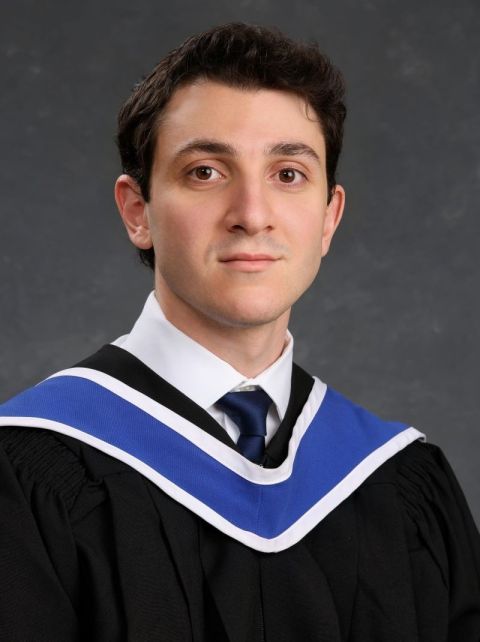
Dante Fasulo, Law’25, is the latest in a long line of Queen’s Law graduates to earn a Supreme Court of Canada (SCC) clerkship. The Montreal native will take up his one-year position in the office of Justice Suzanne Côté in August 2027, after he completes another clerkship, this one at the Court of Appeal for Ontario (ONCA).
“With two clerkships, I think my agenda for the next two years will be pretty full,” Fasulo says with a knowing laugh. “I enjoy trials, but especially appeals. My Court of Appeal clerkship promises to provide me with wonderful opportunities to learn about both types of advocacy.
“I’m also very much looking ahead to clerking at the Supreme Court. There, I’ll be engaging with complex questions of law that are of national interest, and with a level of detail unmatched anywhere else.”
There’s no doubting that Fasulo is well prepared to succeed. And in no small measure that is thanks to the quality of the legal education he acquired at Queen’s Law and to the varied practical experience he has gained since earning his JD in 2025. He has gone well beyond anything he ever dreamed of in his youth in Montreal.
“I’m an only child, and there are no lawyers in my family,” he explains. “Growing up, my aspirations were a bit all over the place — but certainly did not involve clerking at the Supreme Court.”
After earning a BA in philosophy from McGill, he considered pursuing a doctorate before ultimately opting to study law as a more immediate and hands-on path.
Queen’s Law appealed to him largely because of the strength of the school’s faculty in constitutional law — and he is quick to say he made the right decision.
He studied constitutional law with Jacob Weinrib and Mark Walters, both among Canada's foremost constitutional experts. “I really enjoyed their courses and felt inspired to think deeply and critically about the relationship between the individual and the state.” That interest ultimately led him into criminal law. From professors Lisa Kerr and Benjamin Ewing to adjunct professors Daniel Brown and David Tice, both Law’04, there was no shortage of excellent mentorship, says Fasulo. “I learned so much from each of them, and always wanted to come back for one more discussion.”
The knowledge he absorbed and the lessons he learned in those courses and others, and in his extracurricular involvement as an editor of the Queen’s Law Journal prepared him well for summer stints at a small litigation firm in BC in 2023, at the Crown Attorney’s office in Sault Ste. Marie in 2024, and then for his term of articling at the renowned Toronto firm Henein Hutchison Robitaille LLP.
“Having worked on both sides of the bar, I wanted to get a sense of what the law is like from the perspective of the bench. That’s what led me to apply for a clerkship at the Court of Appeal and then at the Supreme Court,” he says.
Each of the nine SCC judges can choose to take on as many as three clerks, and it’s not surprising that competition for those 27 coveted spots is intense. The work experience is invaluable, and going forward it opens an endless range of employment opportunities for the clerks.
“I’ve learned a lot over the last four years. My articles with HHR LLP especially provided me with great insight into appeal work from some of the very best of the criminal defence bar,” says Fasulo. “I look forward to building upon that experience with my clerkships over the next two years. It is truly an opportunity of a lifetime.”
By Ken Cuthbertson, Law’83