
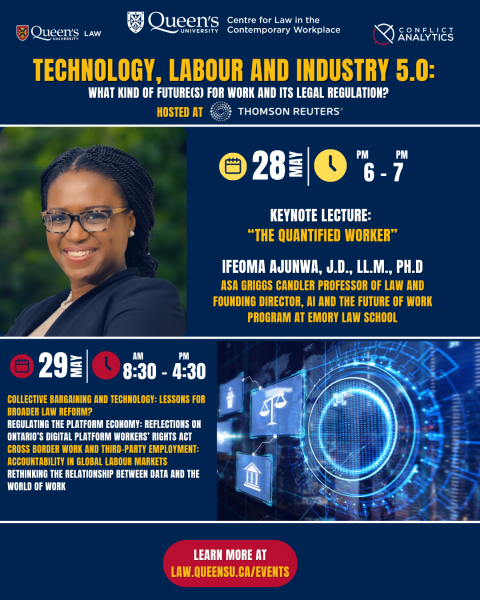
The Centre for Law in the Contemporary Workplace (CLCW) is hosting a timely and thought-provoking conference on the latest revolutions in the world of work. “Technology, Labour and Industry 5.0: What Kind of Future(s) for Work and its Legal Regulation?” will be held in downtown Toronto on May 28 and 29, 2026.
Described as “Industry 5.0,” the current wave of technological change in the world of work is marked by the increasing convergence of human and machine intelligence, layered onto globalized labour markets and digital communication structures — creating growing misalignments between traditional labour law and modern working realities.
“New technologies, especially generative artificial intelligence, are fundamentally changing the world of work today,” says Professor Bethany Hastie, the CLCW’s new director and a leading labour law scholar. “This has presented new challenges for laws governing the workplace, necessitating rapid adaptation and, in some cases, creation of new legal rules.”
The CLCW — a leader in emerging issues in labour and employment law, and the only labour law research centre in a Canadian law school — designed the conference to provide leading-edge information for legal professionals, scholars, law students, policymakers, trade union and employer association representatives, and HR professionals interested in the future of work.
As the labour landscape quickly transforms, and traditional legal principles governing work become outdated, the conference provides unrivalled knowledge on topics including collective bargaining and technology, the regulation of platform work, cross-border and third-party employment, and frameworks for navigating the collection and use of data in the world of work.
“We aim to bring together researchers from a variety of disciplinary backgrounds to provide greater depth and insight in discussing emerging challenges for labour law posed by new forms of technology,” Hastie says. “This will make the conference of value and benefit to attendees from a range of professional settings.”
Overall “the conference will provide opportunities to examine challenges and issues for labour law to address, such as in relation to the introduction of generative AI in the workplace,” Hastie adds. “And it’s an opportunity to explore ways in which labour laws are already attempting to respond to emerging challenges, including through negotiated collective agreements.”
As artificial intelligence rapidly reshapes the modern workplace, few scholars are better positioned to guide participants through its implications than keynote speaker Professor Ifeoma Ajunwa. On May 28, Ajunwa, Asa Griggs Candler Professor of Law and Founding Director of the AI and the Future of Work program at Emory Law School, will deliver a compelling keynote on how AI has moved beyond experimentation to fundamentally transform how workers are recruited, managed, and evaluated.
This free lecture will draw on insights from her acclaimed book The Quantified Worker, examining the growing shift in workplace power from human decision-makers to algorithmic systems — and what this means for workers, employers, and the future of work.
Then on May 29, fourteen leading scholars from Canada, the United States and Europe, will share perspectives on how rapid technological change is posing challenges for the world of work and its regulation. They include Hastie, Lisa Krege from UC Berkely’s Center for Labor Research and Education, and Michele Molè from the Security Technology and ePrivacy Research Group at the University of Groningen in the Netherlands, who will gather to share perspectives. Also of note, Professor Brishen Rogers from Georgetown University’s Faculty of Law will present research from his recent book, Data Democracy at Work: Advanced Information Technologies, Labor Law, and the New Working Class.
Throughout the day, the experts will participate in four panels on urgent topics: “Collective Bargaining and Technology: Lessons for Broader Law Reform?; “Regulating the Platform Economy: Reflections on Ontario’s Digital Platform Workers’ Rights Act”; “Cross Border Work and Third-Party Employment: Accountability in Global Labour Markets”; and “Rethinking the Relationship Between Data and the World of Work.”
Conference attendees will benefit from rich and wide-ranging outcomes. “I expect this event will serve as a launching point for several potential research initiatives moving forward,” Hastie says. “Further, it will provide an opportunity for attendees and panelists to build networks and partnerships with others engaged with, or interested in, these leading-edge issues around the future of work.”
For Ontario lawyers, this program contains one hour and 30 minutes of Professionalism Content, one hour of EDI Professionalism Content, and is eligible for Substantive hours.
For further information and to register, visit the Technology, Labour and Industry 5.0 event page.
By Kirsteen MacLeod