
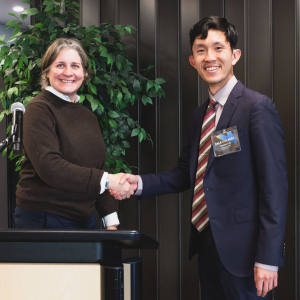
 Professor Preston Jordan Lim has earned the 2026 Canadian Association for Legal Ethics (CALE) Best Paper Award for an article that offers a comprehensive examination of “judicial diplomacy.” This award recognizes outstanding papers written by emerging scholars in the field of legal ethics.
Lim’s article, “Judicial Diplomacy,” recognizes that this term is frequently used to describe the external activities of judges and courts, but its meaning and scope aren’t clearly understood. Previous scholars have offered differing interpretations, with some focusing exclusively on judges’ activities outside the courtroom and others incorporating aspects of dispute resolution.
“Without a clear definition of judicial diplomacy, it has been difficult to understand the full range of these activities and why they matter,” Lim says. His article addresses this gap by proposing a clear, overarching definition.
Lim argues that judicial diplomacy encompasses the various ways judges represent their courts or jurisdictions in engagements with external audiences. He challenges the common assumption that judicial diplomacy is primarily an international phenomenon, demonstrating that it also occurs frequently within domestic contexts, and particularly within federations.
Beyond defining the term, Lim’s article examines the benefits and risks associated with judicial diplomacy. It highlights how judicial engagement can strengthen a jurisdiction’s reputation and influence, enhancing its “soft power” and fostering relationships within and across legal systems. The article also cautions that judges must be careful not to invade the domain of the executive branch.
As judicial diplomacy faces growing scrutiny in certain jurisdictions, Lim argues that judges and courts must be prepared to explain and justify its value. To balance its advantages against its potential drawbacks, he suggests that “judges should engage in some form of cost-benefit analysis before embarking upon judicial diplomacy.”
Lim received his award at the association’s annual conference at Toronto Metropolitan University in October.