
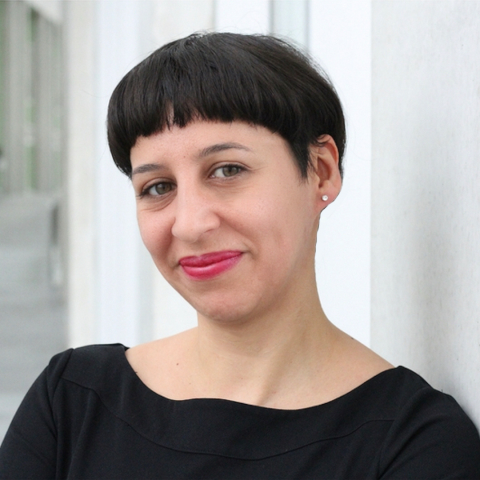
A small number of companies are shaping how artificial intelligence operates in everyday life — often with little public visibility or accountability. Maroussia Lévesque is joining Queen’s Law to study and challenge those power dynamics as a new assistant professor, beginning July 1.
“Maroussia Lévesque is one of the most promising emerging scholars at the intersection of law and artificial intelligence,” says Dean Colleen M. Flood. “Her ability to bridge disciplines and engage diverse audiences is helping shape national and international conversations on AI and the future of law. We are very fortunate to have her join us.”
She brings a uniquely interdisciplinary background and experience across academic, policy, and public-facing work.
Prior to joining Queen’s, Lévesque completed her SJD at Harvard Law School, where she lectured in Comparative AI Governance and was a Fellow at the Weatherhead Center for International Affairs. She previously led AI and human rights work at Global Affairs Canada, collaborated with Amnesty International’s Algorithmic Accountability Lab and the AI Now Institute in New York, contributed to the Global Partnership on AI, and clerked for the Chief Justice of the Quebec Court of Appeal. She holds a JD/BCL from McGill University and a BFA in Computation Arts from Concordia University.
“Over a decade moving between government, civil society, and academia, the same questions kept coming up: who is AI actually working for, and who’s left carrying its costs?” says Lévesque on what drew her to Queen’s at this stage in her career. “I wanted a home base to pursue those questions over the long term, and to do it somewhere genuinely invested in developing the nuances of AI governance beyond the hype. And after years abroad, I’m glad to be doing this work from Canada.”
Her research focuses on AI governance, examining regulatory design, power imbalances and market concentration in the AI industry, and the respective roles of public and private actors in the governance ecosystem. Her current projects analyse how the corporate structures of frontier AI labs shape their behaviour in practice, along with the environmental implications and judicial uses of AI.
“I study the power imbalances AI creates and exacerbates,” she explains. “A handful of companies build these tools while the rest of us live with their decisions: they write the rules, enforce guardrails, and decide what harms and risks their products pose for society, sharing information only as they see fit.”
She points to automated systems that shape decisions about jobs, access to services, or the information people see — often without individuals being told it happened or why, or given a chance to respond.
A related concept she has developed, “analog privilege,” explores how, as more of life becomes automated, opting out of algorithmic systems can become a luxury — often available only to those with existing advantages. She also studies the companies themselves.
“Many frontier AI labs have adopted unusual corporate structures that claim to bake the public interest into their DNA,” she says. “I ask whether those structures actually deliver on that promise, or whether it’s hot air.
“The through-line of my research,” she adds, “is that the power dynamics underlying the AI industry shape the rules long before law catches up.”
Lévesque has published widely in leading journals such as the NYU Journal of Legislation & Public Policy and the University of Illinois Journal of Law, Technology & Policy. She has also written for The Guardian, the Toronto Star, La Presse, The Walrus, and Tech Policy Press.
In the 2026–27 academic year, she will teach a section of Business Associations and her new seminar, Money, Power & AI.
“I want to equip law students with the tools to understand AI and shape its future trajectory,” she says. “My seminar introduces the stakes and challenges of governing AI so students can develop their own perspectives on policy debates.
“I’m also looking forward to joining world-class researchers working on emerging issues like the environmental implications of AI, judicial uses, and Indigenous perspectives,” she adds. “My background blends digital arts and law, and at Queen’s I will continue to convene and foster transdisciplinary discussions.”