
On her 21st birthday, Mary Jane Mossman, Law’70, began her studies at Queen’s Law, at a time when the legal profession was dominated by men. “I was treated as a law student, not a female law student, by classmates and the all-male faculty,” she recalls. “I took good notes, which were always in demand! And there were a tiny number of women — the men didn’t find us a threat.” Mossman, granted a scholarship, was one of five women in her first-year class and the only female to graduate in a class of 100 students.
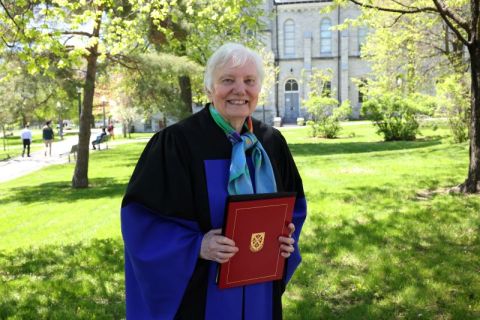
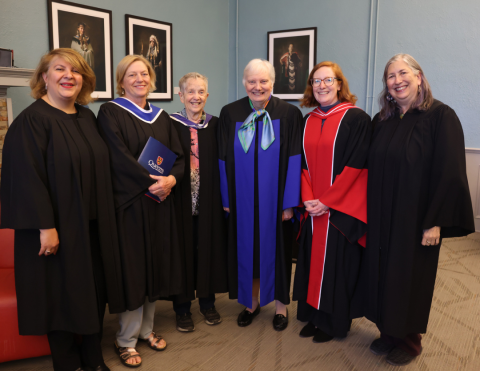
Recently Mossman, a distinguished legal scholar, educator and author, returned to Queen’s campus to receive an honorary Doctor of Laws degree. Over her remarkable career she’s shaped feminist legal studies in Canada, advanced gender equity in the legal profession, and made lasting contributions to access to justice.
Speaking at the Queen’s Law Convocation on May 21, she told the Class of 2026 that since 1970, she has rejoiced to see women lawyers’ numbers — and accomplishments — vastly increasing, with more women than men being called to the Ontario bar in 2026. However, as Law Society reports confirm, “challenges remain, especially for ‘outsiders’ in our profession, who are not white, gentile, middle-class, Canadian-born, physically able, and/or heterosexual.”
For Queen’s Law graduates facing both legal and societal challenges, Mossman offered inspiring words, including a quote from Tommy Douglas. “Courage my friends! It is not too late to build a better world” with law and justice — substantive equality, concrete access to justice, and legal norms of inclusive humanity. She also shared career advice. “Pay attention. Very few of my experiences came because of my plans when I was at law school, but rather because I was prepared to respond to interesting opportunities.”
Mossman’s path emerged from paying attention. “Early on, I responded to the opportunity to become the first articling student at Parkdale Community Legal Services. It became a lifelong commitment to community law clinics and access to justice.” She recalls being branded as a radical. “Legal aid was not well accepted by the Law Society back then; it was new and brought many challenges.” Later Mossman served the organization in various roles, including as Acting Executive Director. She became Legal Aid Ontario’s Clinic Funding Manager, expanding access to justice by opening community legal aid clinics across the province, and has continually supported initiatives such as Friends of Community Clinics, Tribunal Watch, and the Unifor Legal Services Plan.
Half of Mossman’s articling was in the legal clinic, and the other half was at a large corporate firm, where she saw women in law pigeonholed into wills and estates. She decided to accept a law faculty appointment at Australia’s University of New South Wales. In 1977, she became the first woman appointed to full-time faculty at Osgoode Hall Law School, where she taught property and family law courses until her retirement in 2017. “I infused my teaching and student casebooks with legal concepts about exclusion and exclusiveness — thus revealing significant access to justice issues in both property and family law.”
After the Charter’s enactment in 1982, Mossman created Osgoode’s first courses in gender equality and feminist legal theory — huge challenges for her teaching, research, and writing — and she connected to feminist legal scholars worldwide. This, in turn, inspired her scholarship on women in law.
Mossman’s most recent book, Quiet Rebels: A History of Ontario Women Lawyers (Wilfrid Laurier Press, 2024), the culmination of long research, traces the gendered experiences of women in law across six decades of social, economic, and political change. She tells the fascinating stories of all 187 women called to the bar in Ontario from 1897 to 1957, and explores how their experiences of exclusion continue to shape gender issues in the legal profession today.
Among the “quiet rebels,” Mossman says, are two women graduates in Queen’s first law class of 17 students in 1960, both early inspirations for her. Mary Alice Murray was the first Registrar in the Law Faculty, a beloved mentor to generations of Queen’s law students, including Mossman; and her accomplished friend, Geraldine Tepper, pioneered a long legal practice in Kingston.
Mossman says she’s gratefully followed in their footsteps. “As a Queen’s alumna, and the only woman in my graduating class, the stories of these women are special to me. It’s amazing what these early cohorts achieved.”
Law studies at Queen’s planted the seeds for her illustrious career, Mossman adds. Notably, back in second year, she was part of Kingston’s first community law centre at Queen’s. “I think some third-year students convinced the Dean to give them a little money for expenses,” she recalls. “We had a tiny office on the other side of Princess Street with one desk and a phone. It's like the small acorn that becomes a big tree — Queen’s has a remarkably diverse and energetic set of legal clinics now.”
Mossman’s connections to Queen’s have endured, from friendships with classmates and faculty — some her former students — to a visiting professorship. Looking back on her career, characterized by many “firsts,” she says: “I have no regrets about doing law, or doing it at Queen’s, which was wonderful. I feel lucky to have become a lawyer and law teacher for 50 years when women were able to achieve much more than earlier generations.”
By Kirsteen MacLeod