
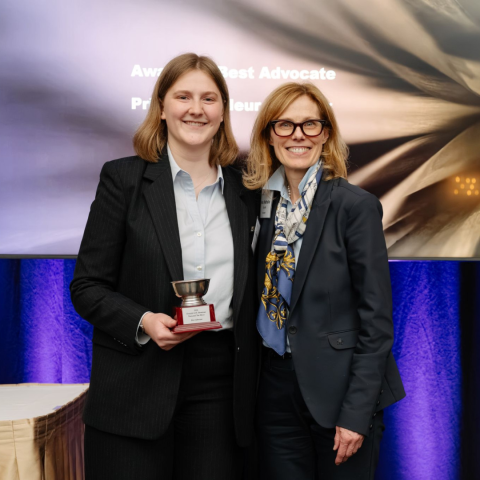
For the second time in three years, the Queen’s Law team has won the Donald G.H. Bowman National Tax Moot. Congratulations to oralists Samantha Curry, Li Yang Qu, Thomas Broccolini and Robert J. Smith, student coach Phillip Martin, and academic coach Martin Sorensen, Law’98, Senior Director at Finance Canada.
Curry, Law’26, and Qu, Law’27, received the Best Overall Team award and Curry was also named Best Advocate.
“The team did an amazing job of critically analyzing the questions raised,” says Sorensen. “They didn’t just re-state the judicial tests in the case law; they re-thought them and came up with a simplified approach. I was most impressed by the team’s growth — it has been a lot of fun to watch both their written and oral advocacy develop over the last few months.”
This year’s moot problem was based on the Federal Court of Appeal’s 2022 decision in Brown v. Canada, which examined whether a money-losing management services arrangement tied to a related art gallery should be characterized as a “business” under section 9 of the Income Tax Act. The case raised long standing questions in tax law about how courts should assess personal motivations, hobby elements, and the pursuit of profit when making this determination.
The team attributes its success to extensive in person practice sessions. Oralists took turns presenting submissions while their teammates acted as judges, asking questions ranging from high level legal principles to detailed points of case law. After each session, the team reviewed their answers and discussed how to strengthen them.
“There were basically no unexpected questions at the moot because we had adequately prepared for all of them,” says Qu.
“It’s important to be able to answer any question thrown at you and then transition back into your submissions seamlessly,” explains Curry. “Being interrupted and thrown off consistently during practice really helped prepare us.”
“We also practiced without any paper in front of us — no script, no factum, no cue cards, nothing,” says Qu. “Reading your script is the worst thing you can do, and reciting from memory is about the second-worst thing you can do. As a result, we were confident going into the moot. We weren’t just there to make our submissions; we were ready to have conversations with the judges.”
After two intense days of mooting against 14 teams from across Canada, the competition concluded with a final awards ceremony at the Omni King Edward Hotel in Toronto. The event brought together students, tax practitioners, and judges from the Federal Court of Appeal and Tax Court of Canada.
The team also thanks their unofficial coaches and special advisors — Sunita Doobay, Law’92, partner at Blaney McMurtry LLP; Jean Marc Leclerc, Law’98, partner at Sotos LLP; and Alexandra MacLean, special advisor to the Canada Revenue Agency — for their invaluable assistance and support.
For future mooters, the 2026 Best Advocate has one key piece of advice. “Go off book,” says Curry. “Judges are looking to have a conversation with you, and going off book allows you to speak more naturally and build a connection through eye contact. While this can be daunting, you know your submissions better than anyone because you wrote them — trust that you know the material and be confident.”