
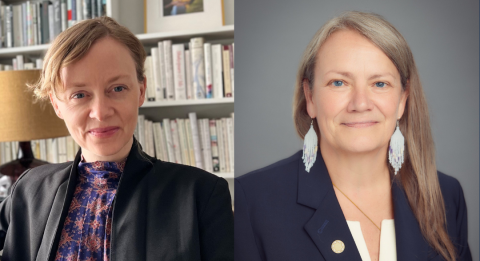
Professors Lisa Kerr and Kimberly Murray have received new funding from the Social Sciences and Humanities Research Council (SSHRC) to lead research projects addressing critical issues of justice and accountability in Canada. The funding has been awarded through SSHRC’s annual Insight Grant competition.
Kerr will examine Ontario’s unique Probono Inmate Appeal Program and its role in expanding access to justice for incarcerated individuals, while Murray is co-leading research on a national initiative to collect and preserve Indian Residential School Survivors’ lawsuit records and other vital evidence that could otherwise be lost.
Kerr’s Project
Kerr’s funding supports her groundbreaking study of Ontario’s Probono Inmate Appeal Program, a unique initiative that provides free legal assistance to incarcerated individuals navigating the province’s appellate courts.
The research, titled “Appeals from Inside: How Prisoners Access Justice at the Ontario Court of Appeal,” will offer the first examination of a program that has operated for more than two decades but has received little scholarly or public attention.
“This project will bring long-overdue visibility to a program that has quietly transformed access to justice for some of the most marginalized individuals in the legal system,” Kerr says.
Addressing a critical gap in legal representation
While individuals convicted of criminal offences in Canada have a right to appeal, many do not qualify for Legal Aid and cannot afford private representation. As a result, incarcerated appellants frequently face the daunting task of navigating complex appellate procedures alone.
The Probono Inmate Appeal Program was established in 1999 to bridge this gap by providing experienced volunteer legal counsel to inmates pursuing appeals. A first in Canada, it remains the only jurisdiction in the country with a formal, ongoing inmate appeal duty counsel program built into its Court of Appeal.
“Without this program, many appellants would face a near-impossible challenge — preparing and arguing appeals in a highly technical area of law without professional assistance,” Kerr explains.
Today, the program relies on a roster of approximately 50 seasoned appellate lawyers who donate their time to review cases, advise incarcerated clients, and argue appeals before the Ontario Court of Appeal.
A unique program with wide-reaching impact
The provincial initiative operates through dedicated court sittings in Kingston and Toronto and uses streamlined procedures designed to make appeals more accessible while maintaining high standards of advocacy.
Inmate appeals now represent a significant portion of the court’s criminal caseload, with thousands of individuals having received assistance through the program over the years.
Despite its scale and importance, the program has remained largely undocumented.
“There is virtually no literature or scholarship on one of Canada’s most innovative access-to-justice programs,” Kerr points out. “So this research has two core goals: to preserve the history of the program and to critically assess its impact on participants and the justice system.”
Broader implications for justice reform
The project will also explore larger systemic questions, including whether reliance on volunteer legal services may mask gaps in public funding for legal aid and whether programs like this serve as models for broader reform.
By examining the program’s successes and limitations, Kerr says the research is expected to generate insights with national and international relevance.
“Ultimately, this project promises to illuminate a vital yet under-recognized part of Ontario’s justice system — one that demonstrates how innovation, collaboration, and commitment to fairness can expand access to justice for those who need it most.”
Murray’s Project
Murray is co-leading research on a five-year initiative aimed at collecting and protecting documented truths of Canada’s Indian Residential School system.
The project, titled “The Indian Residential School Records Project: Legal and Investigative Research for Justice,” responds to a looming national crisis: the scheduled destruction of tens of thousands of Survivor testimonies in 2027.
Murray, Queen’s National Scholar in Indigenous Legal Studies and former Independent Special Interlocutor for Missing Children and Unmarked Graves and Burial Sites, is working on the project alongside Pulitzer Prize–winning Cree journalist Connie Walker, Toronto Metropolitan University (TMU). Together with partners including the Yellowhead Institute, the initiative seeks to ensure that Survivors’ experiences are not lost to history.
A race against time
The project has two important and interrelated aims. The first is to produce a podcast to inform Survivors and Indigenous communities of the pending destruction of more than 38,000 accounts of abuse collected through the Independent Assessment Process. A 2017 Supreme Court of Canada ruling permits these records to be destroyed after September 19, 2027, unless Survivors provide individual Consent to have their files transferred to the National Centre for Truth and Reconciliation. To date, fewer than 100 files have been transferred, raising significant concerns about the adequacy and accessibility of the court-monitored notice program. Vital evidence documenting harms experienced by Survivors, including information on the deaths and disappearances of children, will be forever lost when these records are destroyed.
Secondly, the project aims to find, gather, and preserve the estimated 20,000 Statement of Claims filed by Survivors against the federal government and church entities that operated the institutions in an Indigenous-led archive to protect these accounts. This archive will support Indigenous Peoples’ efforts in seeking justice and accountability.
“This work is about protecting truths and Indigenous persons’ and communities’ right to determine how their histories are preserved,” Murray explains.
Bridging research, law, and investigative journalism
Beyond building on national efforts toward truth and reconciliation, seeking acknowledgment of past harms, the project is designed to secure long-term accountability and access to justice.
Engaging TMU and Queen’s Law students, the research will combine legal analysis with investigative journalism, examining how the Supreme Court’s decision intersects with Indigenous rights, international law, and the preservation of evidence of historical atrocities. It will also involve collecting publicly available legal records — such as pre-settlement statements of claim — to document patterns of abuse at specific institutions.
Indigenous-led, Survivor-centred approach
By focusing on Survivor-centred approaches, the research team aims to support those most affected to guide decisions about how their experiences are collected, protected, and shared.
“Importantly, the initiative will be deeply collaborative,” Murray says. “Survivors, Elders, and community members will guide the development of the archive through advisory councils and gatherings guided by Indigenous knowledge and protocols.” The research’s trauma-informed approach recognizes Indigenous data-sovereignty, ensuring that the process prioritizes dignity, consent, and cultural respect.
Murray points out that the project’s outcomes could reshape how Canada understands its history, while providing Indigenous communities with further evidence to pursue justice and healing.
“By protecting Survivor accounts and amplifying their significance, we want to ensure that the truths of Survivors are not erased and they remain central to Canada’s ongoing journey toward reconciliation.”