
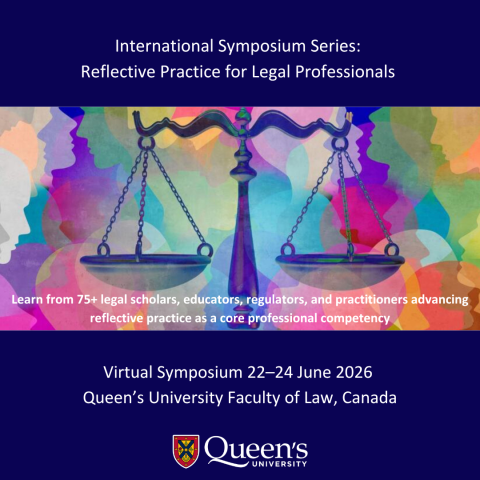
Professor Sharry Aiken and Visiting Scholar and member of the Order of Canada Michele Leering, PhD’23, are the principal organizers of what’s shaping up to be a groundbreaking international symposium. “Reflective Practice for Legal Professionals” will be hosted virtually June 22-24 by Queen’s Law.
Both Aiken and Leering are convinced reflective practice isn’t just an idea whose time has come, it’s one that’s overdue. The three-day virtual symposium — along with four events at partner conferences organized by law-teacher associations in Australia, Canada, and the United Kingdom between now and July — will spotlight reflective practice as a core competency for legal professionals. This enlightened approach to legal education and the practice of law melds theory and practice to develop professional as well as technical knowledge. Most simply put, this methodology includes looking beyond the narrow parameters of legal thought to view issues in a broader context and take time to consider their true meaning and impact. This is an approach to law that’s relatively familiar to clinical legal educators, lawyers who are involved in mediation or negotiations, or alternative dispute resolution.
“I can’t tell you the number of times people have said to me that they thought reflective practice is about navel-gazing. It isn’t. Not at all,” says Leering.
“The term reflective practice has been around since the 1980s, and has gained traction in other professions, most notably in healthcare and education. However, reflective practice has been seriously underappreciated in the Canadian legal profession. This symposium aims to build awareness about what reflective practice is, how to develop this capacity, and how to learn from experience, embrace change, and become more innovative.”
Leering has come to that conclusion and her advocacy of reflective practice after almost four decades of hands-on experience in a non-profit community legal clinic and after having garnered insights and knowledge while earning her doctorate (which was supervised by Aiken and Professor Erik Knutsen). As for Aiken, she developed a commitment to reflective practice through efforts to bridge her experience as a refugee and immigration lawyer with her academic roles as a law teacher and scholar.
“The imperatives for the kind of change we’re talking about and advocating are huge, but they’re also necessary. For example, the Truth and Reconciliation Commission called for law schools and the legal profession to take action to support reconciliation. Being able to reflect deeply, constructively, and to act with integrity is essential. We need to come to terms with the fact that the legal profession has been complicit in historic injustices,” says Leering, “and to take positive steps to make amends.”
Both she and Aiken know bringing about wide-ranging attitudinal change and greater awareness of the value of reflective practice will require a paradigm shift in how we think about the profession. None of that will be easy to bring about.
“For that reason, we’re convening a symposium that will be action oriented and that will produce practical, useful ideas as well as strategies that symposium participants can pick up on and run with,” says Aiken.
Informed by and building upon the research that Leering did while writing her award-winning doctoral thesis, June’s virtual symposium will bring together a broad swath of speakers and participants from at least 19 countries. “We’re trying to seed the ground, build community, give symposium participants opportunities to share their understanding of and their questions about reflective practice,” says Leering.
Faculty from various law schools will take part in the event as will JD and graduate students, lawyers, immigration consultants, regulators, and others. All will have opportunities to explore how disciplined reflection can strengthen the legal profession's response to contemporary challenges and at the same time advance reflective practice across the entire legal educational spectrum and beyond.
More than 120 speakers will deliver presentations at five events — 75 of them at the Queen’s Law symposium. Panels and roundtables will cover a wide variety of topics including reflection across the professional lifespan, well-being in law, international legal perspectives, supporting justice and systemic change, reflective methods, and Indigenous approaches to reflection. The keynote speaker, Professor and Scholar in Higher Education Denise Stockley, the Director of the new Queen’s Institute of Educational and Scholarly Research, will talk about how law teachers can strengthen the Scholarship of Teaching and Learning through their reflective practice.
Leering and Aiken hope their symposium will foster an awareness of the methodology and value of reflective practice that participants will take away with them and will share with colleagues and others. In the short term, the symposium organizers will guest-edit two special issues about reflective practice for widely read international law-teacher journals. They also will prepare and present a report about the Series and recommendations for action at future conferences, organize post-event podcasts, and curate resources on the Series website.
“In the longer term, what we’d like to see is law school curricula reimagined. Law schools in Canada currently deliver a set of competencies as the requirements of accreditation. But they don’t take the next step and map high-level reflective-practice competencies into the courses they’re offering,” says Aiken. “Going forward, the end stage for us will be seeing that transformative change in curricula across the learning continuum. That’s one of the things we hope to see as the fruit of our labours.”
To find out more and to register for this free event, visit the Series website.
By Ken Cuthbertson