
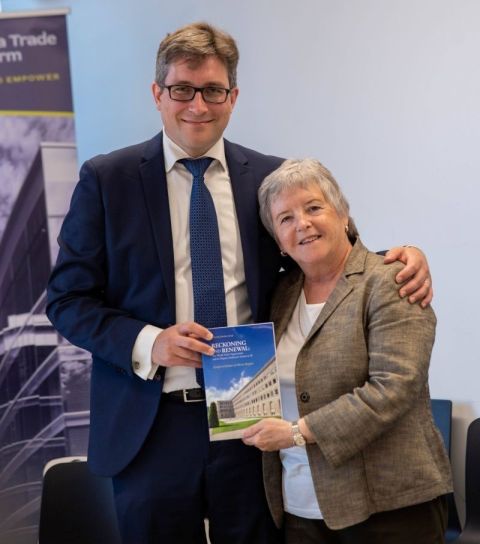
Professor Nicolas Lamp, one of Canada’s leading experts in international trade law, was the catalyst and editor for Reckoning and Renewal: The World Trade Organization and Its Dispute Settlement System at 30, a major new book with a dual purpose.
Given the extent to which U.S. President Donald Trump’s tariff-obsessed polices have upended the framework for long-established global economic relationships and trade networks, the WTO’s place in the world and its future are now awash in uncertainty. That’s a big reason Lamp felt it was important to pause and take stock of where that organization stands. “There’s perhaps no better emblem for the rise and fall of the post-Cold War order than the fate of the WTO and its dispute settlement system,” he explains.
Reckoning and Renewal looks at that system’s achievements and its shortcomings over the past 30 years and attempts to chart a way forward.
The second impetus for this unique volume was Lamp’s desire to salute former Queen’s Law adjunct professor Valerie Hughes, whom Lamp — like many other people who work in the field of international trade law — venerates as a friend and a mentor. “It’s significant that this is the first liber amicorum that’s dedicated to a woman in international trade law,” Lamp proudly points out.
Hughes, a former senior official with the Canadian government and former director of the Legal Affairs Division of the WTO in Geneva, is widely regarded as one of Canada’s leading experts in international trade law. Says Lamp, “The commemoration of the WTO’s 30-year anniversary was subdued given the crisis of its negotiating function and dispute settlement system; recalling Valerie Hughes’s brilliant career provided us with an unambiguous reason for celebration.”
With that in mind, he envisioned a volume that would honour Hughes while also serving as a valuable teaching tool that would tap into what Lamp hails as the “vast amount of valuable specialized information that was out there in the world waiting to be resourced.”
The result of Lamp’s work in compiling and editing this wealth of information is an open-access 618-page reference available online for free. The book consists of three sections. The first provides an analysis of the workings of the WTO’s dispute settlement system over the past three decades. The second examines new developments in dispute settlement. The third looks at rule-making, while exploring the prospects and formats for WTO negotiations generally and the specific contributions the organization can make, most notably in dealing with climate change.
Three years in the making, Reckoning and Renewal includes essays from 44 of the world’s leading authorities in international trade law. Many of these experts are practitioners who don’t normally have the time to write articles; however, when Lamp asked them to do so, he was delighted that most agreed. Included among them are Queen’s Law grads Mallory Felix, Law’24, an International Trade Counsel at Cassidy Levy Kent LLP in Ottawa, and Scott Falls, Law’18, an associate at Lévy Kaufmann-Kohler in Geneva, where he practises international commercial and investment arbitration and public international law as counsel and tribunal secretary. “The eagerness of people to contribute articles underscored for me the importance of the kind of mentorship Valerie Hughes has provided over the course of her career,” says Lamp.
He notes that while Reckoning and Renewal may not be a book that people will read cover-to-cover, it stands as an authoritative reference volume about essential aspects of WTO history and international trade law. As such, readers — especially law students and those who are already working in the field — will refer to it often. Nowhere is that likely to happen more or with greater interest than at Queen’s Law, which has a program in international law — on campus and at Bader College in the U.K. — that’s second to none. “We have students who are graduating with a unique combination of education and exposure to various aspects of international law,” says Lamp.
Some of those students served as Nicolas Lamp’s research assistants and revised the extensive material presented in Reckoning and Renewal. “I owe a huge thank you to Conor Alexander (Law’25), Alara Once (Law’25), Kyla Velonic (Law’27), Megan Coulter (Law’27), and Sierra Wild (Law’27),” says Lamp.
By Ken Cuthbertson, Law’83