
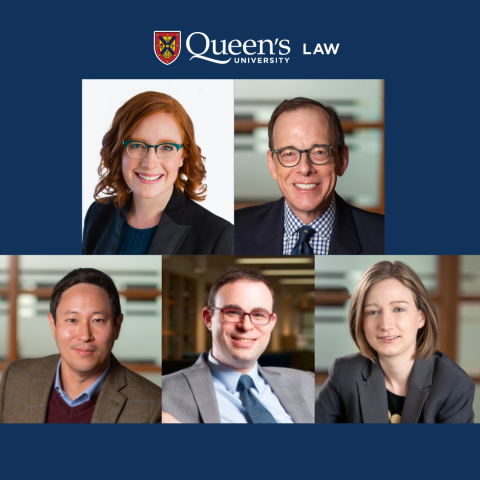
Five Queen’s Law professors — Gail Henderson, Robert Yalden, Ivan Ozai, Josh Karton, and Alyssa King — are tackling some of the most pressing questions in business law. From financial consumer protection, global tax fairness, and corporate governance to arbitration theory and civil justice reform, their research is driving change for businesses, individuals, and policymakers.
Making Financial Markets Fairer for Consumers
Professor Gail Henderson
“Business law regulates the daily lives of every Canadian, including most things we do with our money: how we spend it, how we store it, and how we invest it. When these interactions go smoothly, the extensive and complex regulatory frameworks underlying them tend to go unnoticed. When things go wrong, sometimes with devastating financial consequences, their significance comes sharply into focus.
The overarching question motivating my research is how to improve these regulatory frameworks to make the financial marketplace work better for ordinary Canadians. My research focuses on financial products aimed at and used by consumers living on a low to moderate income.
I have two major research projects related to this question currently in progress. The first one focuses on illegal lending in Canada. The federal government recently lowered the criminal rate of interest to 35 per cent annual percentage rate (APR). One concern with capping the interest lenders can charge is that borrowers considered at high risk of default will be shut out of the legal market for consumer credit and turn to loan sharks. It is difficult to verify this concern, because very little is known about illegal lending in Canada. I aim to shed light on this phenomenon through a study of media stories. The second one is researching and writing an Online Guide to the Regulation of High-Cost Financial Services in Canada. This free, plain-language guide will help improve access to justice by providing information about lenders’ obligations and consumers’ rights with respect to products and services such as cheque cashing and payday loans. It also will provide an accurate and usable reference for community organizations to use in their financial literacy education programs.”
Professor Gail Henderson is Director of the Business Law Program at Queen’s and was appointed the Allgood Professor in Business Law in July 2025. Her expertise has been recognized through appointments to the Financial Consumer Agency of Canada’s Consumer Protection Advisory Committee (2020-2025) and to the Ontario Securities Commission’s Investor Advisory Panel (2025-2027). She has published on recent changes to the criminal rate of interest in the Dalhousie Law Review and the Canadian Business Law Journal. The Online Guide to the Regulation of High-Cost Financial Services is supported by a grant from the Canadian Foundation for Legal Research.
Who shapes business law?
Professor Robert Yalden
“My research focuses on the forces that shape both the institutions that oversee the development of business law, and the principles that those institutions uphold. For example, I’ve examined how courts and securities regulators in Canada deal with contentious transactions involving corporate acquisitions — and why these institutions have different views about whose interests matter most. Securities regulators focus on investors, while courts look at what is best for the company as a whole. This gives rise to tensions that we need to resolve because boards of directors will otherwise continue to face conflicting guidance — for example, when a board is concerned about the merits of an offer to buy the company that some shareholders nonetheless find financially attractive and want the board to accept.
My most recent work looks at the decision taken in the 1990s to give securities commissions the power to make legally binding rules. This has greatly expanded their ability to shape business law and it raises important questions about how securities commissions develop those rules. I have focused on whether mandated procedures intended to foster public participation in rule making — which it was argued would ensure democratic legitimacy — have done the job. I am finalizing a SSHRC-funded study that for the first time considers who is, and is not, participating. Surprisingly, retail investors are frequently absent from discussions about what disclosure will be most useful to them. So are Indigenous communities, even when securities commissions are dealing with significant issues of real importance to these communities, such as climate change disclosure. My goal is to spur a long overdue discussion among policymakers about changes to rule-making procedures needed to secure appropriate participation and, ultimately, the legitimacy of the rules that are being adopted.”
Professor Robert Yalden is the Stephen Sigurdson Professor in Corporate Law and Finance and Co-Editor in Chief of the Canadian Business Law Journal. He received an Insight Development Grant from the Social Sciences and Humanities Research Council for his project, “Rulemaking in Canadian securities law: structures of deliberation and their implications for democratic legitimation.” He recently led 10 scholars in publishing the third edition of Business Organizations: Practice, Theory & Emerging Challenges, the most current and innovative text on Canadian business law, and also co-authored the newest edition of Securities Law in Canada: Foundations, Policy and Practice.
Tax law and global fairness
Professor Ivan Ozai
“How can tax law be designed to distribute the costs of government fairly while keeping pace with global economic change?
My research explores how tax rules shape fairness and justice, both within domestic systems and across the global economy. I examine how tax law distributes resources, affects economic behaviour, and can either reduce or entrench inequality.
A central concern in my work has been the fairness of international tax rules. I have shown how global reforms, often led by the OECD, disproportionately favour wealthier countries while limiting the ability of developing states to raise revenue for essential public services. I have also examined how tax competition should be curbed and how the costs of reform ought to be fairly shared among countries. More recently, I have also revisited the principle of inter-nation equity, proposing reforms that would allocate tax jurisdiction in ways that better address global poverty and inequality.
I am currently working on tax avoidance and the ways the law seeks to prevent it. My research looks at how legal rules try to draw the line between legitimate tax planning and arrangements that cross into abuse. Some rules aim for simple, clear boundaries, while others give judges more flexibility to consider the substance of a transaction. I explore how these different approaches influence business behaviour and how courts evaluate what counts as fair.
My scholarship as a whole shows how technical tax rules, whether domestic or international, carry profound consequences for fairness and competitiveness. By making these consequences clearer, I aim to contribute to the design of more just and sustainable tax systems.”
Professor Ivan Ozai joined Queen’s Law on July 1, 2025, as the inaugural Queen’s Faculty Scholar in Tax Law and Policy. His recent publications include “Global Justice in the Reshaping of International Tax” in the Journal of International Economic Law, “Judicial Line-Drawing and Implications for Tax Avoidance” in the Canadian Tax Journal, and “Beyond Economic Allegiance” in the University of Toronto Law Journal. He is the founding convenor of the Queen’s Colloquium on Tax Law and Policy.
Rethinking arbitration
Professor Josh Karton
“My research focuses on domestic and international contract law and dispute resolution, especially arbitration. While arbitration is an increasingly important way to resolve commercial disputes (especially in Canada, where court backlogs have pushed parties toward arbitration), it remains little understood — and often distrusted — by non-specialists. My research seeks to reveal how arbitration actually works in theory, in law, and in practice. I have a particular interest in the impact of culture on international arbitration practice: how different legal, national, linguistic, and religious cultures interact to shape this form of international private justice.
My main ongoing project, “Contracts all the Way Down: A Contractarian Theory of Arbitration,” argues that the conventional view of arbitration is backward. Instead of privatizing public civil justice, arbitration is the public enforcement of private justice. When parties agree to arbitrate, they delegate to the arbitrator the power to determine what their contract means and what consequences follow. In this way, an arbitrator is a sort of stipulated remedy clause in human form — an instrumentality of the parties’ contract rather than a private judge. This insight has important practical consequences, in particular for the role of courts in regulating arbitration.
I also “bring theory to practice,” as an arbitrator and in rulemaking and law reform initiatives. For example, in the past two years I have served on committees of the International Bar Association (drafting international rules of legal privilege in arbitrations), and the ADR Institute of Canada (overhauling its arbitration rules), and have sat as an arbitrator in domestic and international commercial disputes.”
Professor Joshua Karton is the Associate Dean for Graduate Studies and Program Development at Queen’s Law. He co-founded and is Managing Editor of the Canadian Journal of Commercial Arbitration, serves as a book review editor for the American Journal of Comparative Law, and is a general editor of Kluwer Arbitration Practical Insights (a leading online research guide for international arbitration practitioners). His “Contracts all the Way Down” project is funded by a grant from the Social Sciences and Humanities Research Council of Canada.
Civil justice goes global
Professor Alyssa King
“My research explores how civil justice systems are becoming global and what that means for businesses and individuals.
One major focus is international commercial courts — domestic courts that handle foreign-related disputes, that is disputes with foreign parties, or sometimes foreign subject matter. I’ve co-authored papers on their hiring of foreign judges and am now studying their decisions to see how they might influence international commercial law.
Closer to home, I contributed to Ontario’s consultation on procedural reform. Ontario’s courts are compared to major commercial litigation centres, but reforms will only succeed if courts have the resources to implement them. While some industries, like construction, rely heavily on private arbitration — a process where disputes are resolved by a neutral arbitrator instead of going to court — timely court decisions remain essential for Ontario businesses. They provide legal certainty, which supports long-term planning. Even arbitration here is shaped by Ontario’s Rules of Civil Procedure, so court reforms matter not just for litigants but for the broader legal system.
I’m also working with colleagues on how summary judgment — a decision by a judge to resolve a lawsuit without a full trial — is used in Ontario, a key issue as proposed reforms could change this process significantly. Our next phase will examine self-represented parties, which is especially relevant for small businesses and sole proprietors who may be unable to afford a lawyer.
Finally, I study how procedural changes spread and what that means for the business of law — not just law firms but all service providers who benefit from legal work. Around the world, many jurisdictions engage in “forum selling,” competing to attract legal disputes to boost local economies. While not inherently bad, forum selling can shape courts and legal rules to favor certain interests over others.”
Professor Alyssa King was awarded a SSHRC Insight Development Grant in 2020 (with Pamela K. Bookman) for “Travelling Judges, Moonlighting Arbitrators, and Global Common Law” and was part of a research team awarded a SSHRC Insight Development Grant in 2024 (with Suzanne Chiodo and Gerard Kennedy) for “Fighting the Backlog: How Ontario’s Courts are Using Summary Processes to Address Civil Justice Delays.” She recently published “Ethics for Traveling Judges” in the University of Toronto Law Journal.
Business law research at Queen’s spans a wide range of topics and approaches. Read about international trade law expert Professor Nicolas Lamp and the intensive course he has developed for business and legal professionals, Trade Law Essentials: What Businesses Need to Know. While this story highlights five professors, they are part of a larger group of faculty whose work contributes to the evolving field of business law — making it fairer, more efficient, and more responsive to global change.