
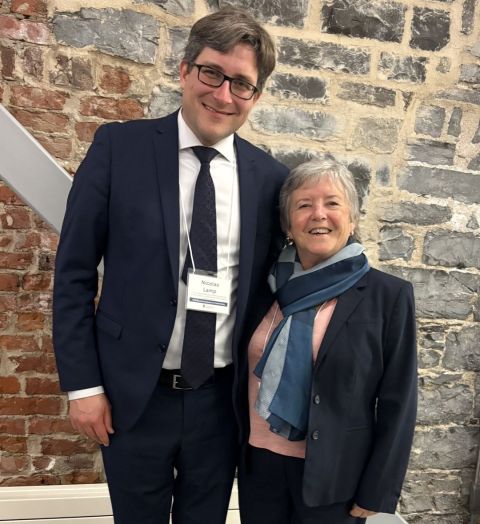
Canada finds itself at what Prime Minister Mark Carney has called a “hinge moment” in its international economic relations. With a more protectionist United States imposing tariffs on key Canadian exports and China continuing to expand as an industrial powerhouse, the country faces mounting trade challenges. To help Canadian trade officials respond to this shifting landscape, Professor Nicolas Lamp recently convened leading experts for “Trading in Disorder: A Trade Strategy for Navigating US Protectionism and Chinese Industrial Policy,” the 2026 edition of the Queen’s Institute on Trade Policy.
Held April 13–15 in Kingston, the three‑day Institute examined the impact of U.S. trade policy and China’s industrial strategy on Canada’s economy, explored major policy challenges, and considered their implications for Canada’s future trade strategy.
“The concept of ‘economic security’ is increasingly becoming a new paradigm through which many governments, from Canada to the European Union to China, are viewing their trade relations,” says Lamp of one key takeaway. “The concept combines the need to be resilient against coercion and external shocks with a determination to become more self-reliant.”
Another major theme was the reemergence of “managed trade,” involving stronger government oversight of trade flows. “One example,” Lamp explains, “are the so-called tariff rate quotas that the Canadian government has imposed on imports of steel and on electric vehicles from China.”
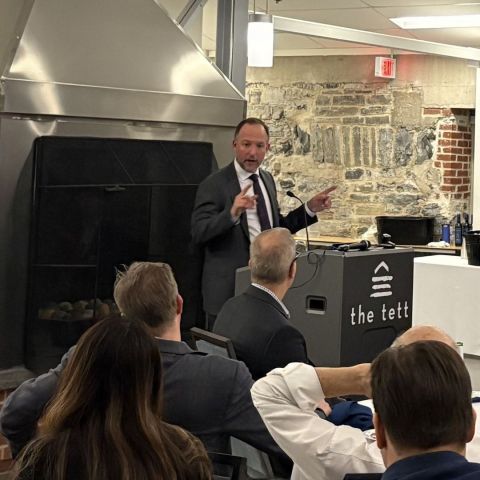
The Institute’s keynote speakers reinforced the need for a shift in approach. Aaron Fowler, Associate Assistant Deputy Minister and Chief Trade Negotiator at Global Affairs Canada, concluded the first day with a keynote on “Canadian Trade Policy for the New Disorder.” He emphasized that, as Carney noted in Davos, we live in a time of “rupture,” a completely different world where we can no longer rely on old certainties.
In a second keynote, the Honourable John Hannaford, Personal Representative of the Prime Minister of Canada to the European Union, focused on building partnerships to navigate today’s geopolitical uncertainty. He underscored the need for a trade policy that prioritizes opening commercial opportunities for Canadian businesses across a broader range of markets.
The 2026 Institute welcomed 66 participants, primarily from Global Affairs Canada, along with officials from other federal departments and agencies and several provinces. Attendees included trade policy analysts, trade commissioners, and other officials from across Canada’s trade policy community.
“Canadian trade officials are experts, but they are experts in increasingly narrow fields,” says Lamp. “The Institute gives them a better understanding of broader trends in the trade policy landscape. It also helps them to understand the challenges that their colleagues in other parts of the government are confronting, which will hopefully lead to better intra-government collaboration and coordination.”
Since 2019, Lamp has served as Director of the Queen’s Institute on Trade Policy, widely recognized as the premier training course for trade officials in Canada. The Institute helps bring Canadian government officials up to speed on cutting-edge research and thinking from academia and the policy research community on trade policy trends, concepts, and tools, while giving them the opportunity to hear from and engage with leading experts from Canada, the United States, and beyond.
“It also allows them to learn from each other in a frank and open discussion in a new environment outside the office,” Lamp adds.